
The FIRE movement emerged from the personal finance community in the early 2010s, inspired by books like "Your Money or Your Life" by Vicki Robin and "Early Retirement Extreme" by Jacob Lund Fisker. The core philosophy is straightforward: by dramatically increasing your savings rate and reducing expenses, you can accumulate 25-30 times your annual spending within 10-20 years rather than the traditional 40-year career. Financial independence - the "FI" in FIRE - means having enough invested assets to cover your living expenses indefinitely through investment returns, without needing employment income. The "RE" (retire early) is optional and sometimes controversial within the community. Many FIRE adherents do not actually stop working entirely; instead, they transition to work they find meaningful without financial pressure. The movement has grown from a niche online community to a mainstream personal finance strategy, with thousands of blogs, podcasts, and forums dedicated to sharing strategies, tracking progress, and supporting practitioners through the psychological challenges of pursuing an unconventional financial path.
What Is the FIRE Movement? A Complete Beginner's Guide
Everything you need to know about Financial Independence, Retire Early (FIRE) - the philosophy, the math, different FIRE variants, and how to get started.
Published: March 8, 2026
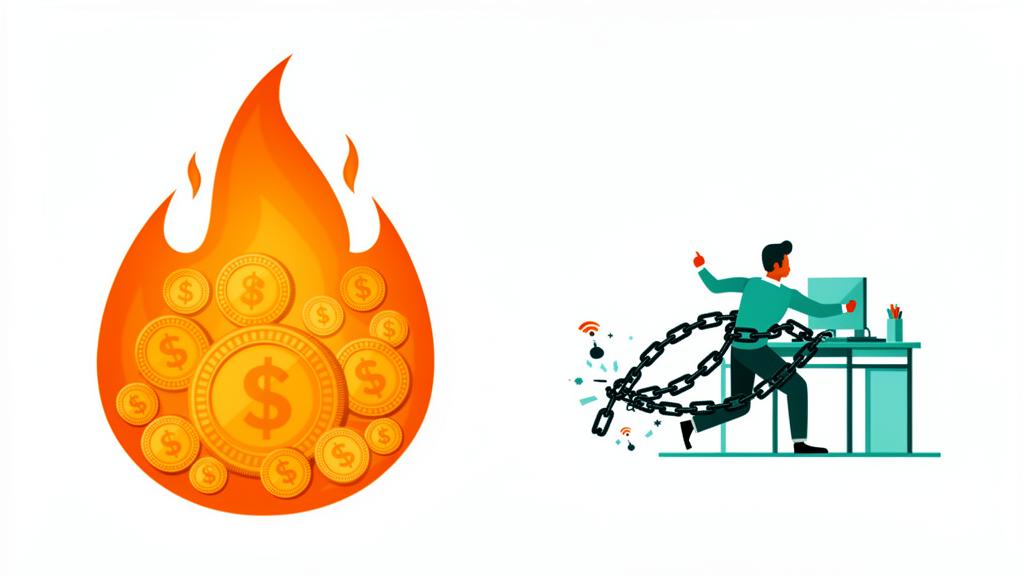
What Does FIRE Stand For?
FIRE stands for Financial Independence, Retire Early. It is a lifestyle movement focused on extreme savings rates, frugal living, and strategic investing to accumulate enough wealth to retire decades before the traditional age of 65.
How to Calculate Your FIRE Number
Your FIRE number is typically 25 times your annual expenses, based on the 4% safe withdrawal rate. If you spend $40,000 per year, your FIRE number is $1,000,000. More conservative practitioners use 30-33 times expenses.
Your FIRE number represents the portfolio value at which you can sustain your lifestyle indefinitely from investment returns. The standard calculation multiplies your annual expenses by 25, derived from the 4% safe withdrawal rate established by the Trinity Study. This means a $1,000,000 portfolio can theoretically support $40,000 per year in spending, adjusted for inflation, with a very high probability of lasting 30+ years. The critical variable is your annual spending, not your income. A person earning $200,000 who spends $100,000 needs $2,500,000 to reach FIRE. A person earning $80,000 who spends $30,000 needs only $750,000 - and reaches FIRE much faster because they save a higher percentage of their income. This insight is the mathematical engine of the FIRE movement: reducing expenses simultaneously decreases the amount you need to save while increasing the rate at which you save it. A double benefit that dramatically accelerates the timeline. Many FIRE practitioners use more conservative multipliers of 28-33 times expenses (corresponding to 3.0-3.5% withdrawal rates) to provide additional safety margin for early retirements lasting 40-50 years.
Why Does Savings Rate Matter More Than Income?
Your savings rate determines how quickly you reach financial independence. At a 50% savings rate, you can retire in roughly 17 years. At 75%, you can retire in about 7 years, regardless of your actual income level.
The FIRE community emphasizes savings rate as the single most important metric because it captures both sides of the equation - how much you earn relative to how much you spend. A person saving 10% of their income needs to work approximately 51 years to retire. At 25%, the timeline drops to 32 years. At 50%, it falls to just 17 years. At 75%, financial independence arrives in roughly 7 years. These calculations assume a 5% real (after-inflation) investment return and are surprisingly robust across different income levels. The math works because a high savings rate does two things simultaneously. First, it accelerates wealth accumulation by directing more money into investments. Second, it proves you can live on less, which directly reduces your FIRE number. A $200,000 earner who spends $180,000 (10% savings rate) needs $4,500,000 to retire. A $200,000 earner who spends $60,000 (70% savings rate) needs only $1,500,000 - one-third the target saved at seven times the rate. This explains why many successful FIRE practitioners earn moderate incomes but maintain disciplined spending habits rather than being exceptionally high earners.
What Are the Different Types of FIRE?
FIRE has several variants: Lean FIRE (retiring on minimal expenses, under $40,000/year), Fat FIRE (retiring with a lavish lifestyle, $100,000+/year), Coast FIRE (enough saved to stop contributing but continue working), and Barista FIRE (part-time work covers expenses while investments grow).
The FIRE movement has evolved beyond a single approach to encompass several distinct philosophies. Lean FIRE practitioners target the lowest possible spending level, typically $25,000-$40,000 per year for an individual or couple. This requires a FIRE number of $625,000-$1,000,000 - achievable in 10-15 years for moderate earners with extreme frugality. The trade-off is a constrained lifestyle with little room for unexpected expenses. Fat FIRE targets a more luxurious retirement with annual spending of $100,000 or more, requiring $2,500,000+ in savings. Fat FIRE typically appeals to high earners who want financial independence without significant lifestyle sacrifices. Coast FIRE is reached when you have saved enough that compound growth alone will fund a traditional retirement at 65 - you stop contributing to retirement accounts but continue working to cover current expenses. A 30-year-old who has $200,000 invested is essentially at Coast FIRE, since that amount will grow to approximately $1,500,000 by age 65 at 7% real returns. Barista FIRE involves semi-retirement: your investments cover most expenses while a low-stress part-time job provides supplemental income and potentially employer healthcare benefits.
How to Get Started With FIRE
Start FIRE by tracking every dollar you spend for 30 days, eliminating your largest unnecessary expenses, maximizing tax-advantaged retirement accounts, and investing in low-cost index funds.
Beginning your FIRE journey requires four fundamental steps. First, track your spending meticulously for at least one month. Most people are shocked to discover where their money actually goes. Subscriptions, dining out, impulse purchases, and lifestyle inflation often consume 20-40% of income without providing proportional happiness. Second, calculate your current savings rate and FIRE number. This creates a concrete target and timeline that transforms an abstract goal into a measurable plan. Third, optimize the "big three" expenses that consume 70% of most budgets: housing, transportation, and food. Moving to a smaller home, driving used cars, and cooking at home can increase your savings rate by 15-25 percentage points - more impactful than eliminating daily coffee. Fourth, invest the difference in low-cost total market index funds through tax-advantaged accounts: employer 401(k) to the match, then Roth IRA to the maximum, then back to the 401(k), then taxable brokerage accounts. Automate all contributions so savings happen before you see the money. The FIRE journey is a marathon, not a sprint - sustainable habits maintained for a decade outperform extreme deprivation that leads to burnout.
What Are the Risks and Criticisms of FIRE?
Critics argue FIRE relies on optimistic market assumptions, ignores healthcare costs, requires privilege to achieve, and can lead to social isolation. Sequence of returns risk is the biggest financial threat to FIRE practitioners.
The FIRE movement faces several legitimate criticisms that practitioners should honestly evaluate. The most significant financial risk is sequence of returns - retiring into a severe bear market early in your FIRE journey can permanently impair your portfolio. Unlike traditional retirees who have Social Security and pensions to fall back on, many FIRE practitioners rely entirely on their investment portfolio. Healthcare represents another major challenge, particularly in the United States where employer-sponsored insurance is the primary coverage model. Early retirees must self-fund healthcare for decades before Medicare eligibility, and a serious medical event can devastate a lean FIRE portfolio. Critics also note that FIRE is most achievable for high earners without student debt, family obligations, or disabilities - the movement's emphasis on personal responsibility can overlook systemic barriers to wealth accumulation. Psychologically, extreme frugality during the accumulation phase can strain relationships and create an unhealthy obsession with money. Some FIRE retirees report feelings of purposelessness, loss of identity, and social isolation after leaving the workforce. The most successful FIRE practitioners build rich lives outside of work before retiring, not after.
FIRE Success Stories and What They Teach Us
Successful FIRE practitioners share common traits: they started tracking spending early, automated their savings, invested consistently in index funds through market downturns, and found purpose beyond work before retiring.
Analyzing FIRE success stories reveals patterns that transcend income levels and backgrounds. Most successful practitioners did not earn extraordinary incomes - many achieved FIRE on household incomes of $80,000-$150,000 by maintaining expenses at $30,000-$50,000. The common thread is the gap between earnings and spending, maintained consistently for 10-20 years. Geographic arbitrage - living in lower-cost areas while earning higher-cost-area wages (increasingly possible with remote work) - has accelerated timelines for many. Dual-income couples have a significant advantage, as shared housing costs effectively double their savings rate. Perhaps the most important lesson from successful FIRE practitioners is that financial independence changes your relationship with work more than it eliminates work. Many continue to earn income through passion projects, consulting, teaching, or part-time roles - but they do so by choice rather than necessity. This psychological shift from "I have to work" to "I choose to work" is often described as the most valuable outcome of the FIRE journey, worth pursuing even if you never fully retire. The financial security provides freedom to take risks, pursue meaningful work, and say no to situations that compromise your values.

Frequently Asked Questions
The timeline depends entirely on your savings rate. At a 50% savings rate with 7% real returns, financial independence takes approximately 17 years. At 65% savings rate, about 10 years. At 75%, roughly 7 years. Most FIRE practitioners work 10-20 years before reaching financial independence.
No, but higher incomes make FIRE easier and faster. The key metric is savings rate, not income. A teacher earning $55,000 who saves 50% ($27,500/year) reaches FIRE faster than a lawyer earning $200,000 who saves 10% ($20,000/year). However, very low incomes make achieving meaningful savings rates extremely difficult.
No. Many FIRE practitioners have families with children. Kids do increase expenses, but families can still achieve high savings rates through intentional choices about housing, education, activities, and lifestyle. Some families achieve FIRE by leveraging dual incomes during the accumulation phase.
Most FIRE retirees fill their time with activities they find meaningful: volunteer work, hobbies, travel, part-time passion projects, writing, fitness, community involvement, and spending time with family. Many report being busier after retiring than while working, but doing things they choose rather than things they must.