
Debt-to-income ratio is one of the most important metrics lenders use to evaluate your ability to manage monthly payments and repay borrowed money. The calculation is straightforward: add up all your required monthly debt payments, divide by your gross (pre-tax) monthly income, and multiply by 100 to get a percentage. For example, if you earn $6,000 per month gross and pay $500 for a car loan, $300 for student loans, $200 for credit card minimums, and $1,200 for rent or mortgage, your total monthly debt payments are $2,200. Your DTI is ($2,200 ÷ $6,000) × 100 = 36.7%. Lenders use DTI because it provides a clear picture of your financial obligations relative to your earning capacity. A low DTI indicates you have plenty of income remaining after debt payments to handle new obligations and unexpected expenses. A high DTI signals that you are stretching your income thin, making you a riskier borrower. Unlike credit scores, which measure your history of managing debt, DTI measures your current capacity to take on additional debt - a forward-looking assessment of financial health.
What Is a Good Debt-to-Income Ratio? Complete Guide
Understand debt-to-income ratio - how to calculate it, what lenders consider good, and practical strategies to improve your DTI for better loan terms.
Published: March 8, 2026
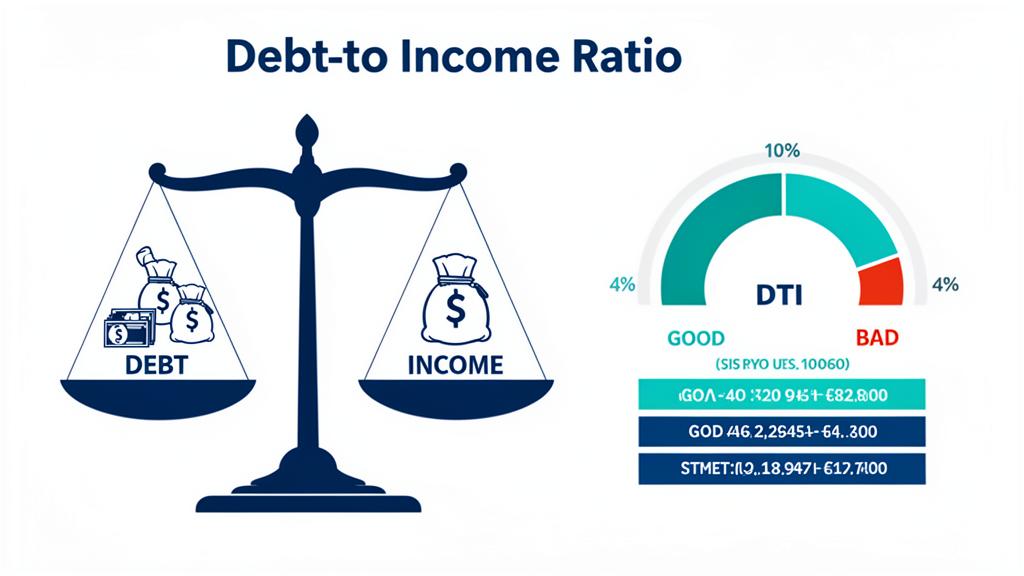
What Is Debt-to-Income Ratio (DTI)?
Debt-to-income ratio measures the percentage of your gross monthly income that goes toward debt payments. It is calculated by dividing total monthly debt payments by gross monthly income and multiplying by 100.
What Counts as Debt in DTI Calculations?
DTI includes mortgage or rent, car loans, student loans, credit card minimum payments, personal loans, child support, and alimony. It does not include utilities, groceries, insurance premiums, phone bills, or subscriptions.
Understanding what counts and does not count in DTI calculations is essential for accurate self-assessment and mortgage planning. Debts included in DTI are recurring financial obligations that appear on your credit report: mortgage payments (including principal, interest, taxes, and insurance - known as PITI), auto loan payments, student loan payments (even if in deferment, lenders often use 0.5-1% of the balance as a proxy payment), credit card minimum payments (not your total balance), personal loan payments, home equity loans or lines of credit, child support and alimony payments, and co-signed loan payments. Debts not included in DTI: utility bills, cell phone bills, groceries, gas, streaming subscriptions, gym memberships, health insurance premiums, car insurance, daycare costs, and other living expenses. While these expenses affect your actual cash flow, lenders exclude them from DTI because they are not contractual debt obligations. This distinction matters for planning: reducing your gym membership or streaming services will not improve your DTI. Paying off or paying down a car loan, student loan, or credit card balance will directly lower your DTI and improve your borrowing capacity.
What DTI Do Lenders Consider Good?
Most lenders prefer a DTI below 36%, with no more than 28% going toward housing costs. FHA loans allow DTIs up to 43-50%, while conventional loans typically require below 45%. Below 20% is considered excellent.
Lenders categorize DTI ranges into tiers that affect loan approval, interest rates, and available terms. Below 20% is excellent - you are well within your means and will qualify for the best rates and terms from any lender. Lenders view you as very low risk with substantial income remaining for new obligations. Between 20-36% is good - this is the target range most financial advisors recommend. You will qualify for most loan products with competitive rates. The 28/36 rule, a long-standing lending guideline, suggests spending no more than 28% of gross income on housing costs (front-end ratio) and no more than 36% on total debt payments (back-end ratio). Between 36-43% is acceptable - you can still qualify for most mortgages, but you may face slightly higher interest rates or additional documentation requirements. This range suggests your debt load is significant and new borrowing should be approached cautiously. Between 43-50% is the maximum for most loan programs. FHA loans allow DTIs up to 50% with compensating factors (strong credit score, significant savings, or stable employment history). Conventional loans from most lenders cap at 43-45%. Above 50%, most lenders will decline the application regardless of other qualifications.
How Does DTI Affect Your Mortgage Application?
DTI is one of the three most important factors in mortgage approval, alongside credit score and down payment. A lower DTI not only improves approval odds but can also qualify you for lower interest rates, saving thousands over the loan term.
In mortgage underwriting, DTI serves as a critical capacity test - it answers whether you can realistically afford the new mortgage payment on top of existing obligations. Most automated underwriting systems treat DTI as a hard cutoff: exceed the maximum and your application is automatically declined regardless of a perfect credit score or large down payment. For conventional loans conforming to Fannie Mae guidelines, the maximum DTI is typically 45% (up to 50% with strong compensating factors). FHA loans allow up to 43% standard and up to 57% with automated underwriting approval and significant compensating factors. VA loans technically have no DTI limit but use a residual income test that serves a similar purpose. Beyond the approval threshold, DTI affects the interest rate you receive. Borrowers with DTIs below 30% often receive rate discounts of 0.125-0.25% compared to borrowers at 43% - on a $300,000 mortgage, this saves $20,000-40,000 over 30 years. DTI also determines your maximum loan amount. If your gross income is $8,000 per month and you have $1,000 in existing debts, a 43% DTI cap means total debts including the new mortgage cannot exceed $3,440 per month, limiting your mortgage payment to $2,440. This directly caps your purchase price regardless of home values in your market.
How to Calculate Your DTI Ratio Step by Step
Add all monthly debt payments (mortgage, car, student loans, credit card minimums, personal loans). Divide by gross monthly income. Multiply by 100. Example: $2,500 in payments ÷ $7,000 income = 35.7% DTI.
Calculating your DTI accurately requires gathering all your financial information. Step 1: Determine your gross monthly income. For salaried employees, divide your annual salary by 12. If you earn $84,000 per year, your gross monthly income is $7,000. For hourly workers, multiply your hourly rate by average weekly hours and then by 52, divided by 12. For self-employed individuals, lenders typically use the average of your last two years of net self-employment income as reported on tax returns. Include regular bonuses, commissions, rental income, alimony received, and other documented recurring income. Step 2: Total all monthly debt payments. List every required minimum payment: mortgage or rent ($1,500), car payment ($400), student loans ($300), credit card minimums ($150), personal loan ($150). Total: $2,500. Step 3: Divide and multiply. $2,500 ÷ $7,000 = 0.357 × 100 = 35.7% DTI. If you are planning to apply for a mortgage, also calculate your projected DTI including the new mortgage payment to see if you will stay under the lender's maximum threshold. Many mortgage calculators include DTI projections to help you determine your maximum affordable home price.
Proven Strategies to Lower Your DTI Ratio
Lower your DTI by paying down debt (especially credit cards and car loans), increasing income through raises or side income, avoiding new debt, and refinancing existing loans to lower payments.
Lowering your DTI requires either reducing the numerator (monthly debt payments) or increasing the denominator (gross monthly income). Debt reduction strategies include paying off credit card balances to eliminate minimum payments from your DTI (paying off a $5,000 card removes $100-150 per month from your debt total), paying off a car loan or student loan, and making lump-sum payments to reduce balances and corresponding minimum payments. Refinancing existing debts to lower rates or longer terms reduces monthly payments. Extending a car loan from 48 to 60 months or refinancing student loans at a lower rate directly lowers your DTI, though it may increase total interest paid. Income strategies include requesting a raise, taking on documented overtime, starting a documented side business (lenders typically want to see two years of consistent self-employment income), or adding a co-borrower with income to the mortgage application. Timing strategies matter for mortgage applications specifically: avoid opening new credit accounts, financing large purchases, or co-signing loans in the months before applying. Even closing an unused credit card during this period can be counterproductive if it increases your utilization ratio on remaining cards.
Front-End vs Back-End DTI: What Is the Difference?
Front-end DTI includes only housing costs (mortgage, taxes, insurance, HOA). Back-end DTI includes all debts. Lenders evaluate both - the 28/36 guideline means housing costs below 28% and total debts below 36% of gross income.
Lenders assess two separate DTI ratios to evaluate borrowers comprehensively. The front-end ratio (also called the housing ratio) measures only housing-related costs as a percentage of gross income. This includes the mortgage principal and interest payment, property taxes, homeowner's insurance, private mortgage insurance (PMI) if applicable, and homeowners association (HOA) fees. The front-end ratio isolates the single largest expense to ensure it does not consume too much of your income. Most lenders prefer a front-end ratio below 28%, though FHA allows up to 31% and some conventional programs accept up to 33%. The back-end ratio (total DTI) adds all other debt payments on top of housing costs. This comprehensive view shows your total debt burden relative to income. Conventional lenders typically cap the back-end ratio at 43-45%, while FHA and VA loans may allow higher ratios. If your front-end ratio is acceptable but your back-end ratio is too high, it signals that non-housing debts are too large - paying off car loans, credit cards, or personal loans will be necessary to qualify. Conversely, if your back-end is fine but your front-end is high, you may be looking at homes beyond your comfortable price range.

Frequently Asked Questions
The ideal DTI is below 20% for maximum financial flexibility and the best loan terms. A DTI between 20-36% is considered healthy and comfortable for most households. Above 36%, you are carrying significant debt relative to your income and should prioritize debt reduction before taking on new obligations.
If you currently rent, your rent payment is typically not included in DTI calculations for a mortgage application because it will be replaced by the new mortgage payment. However, if you will continue renting a property while buying another (as an investment), both the rent and mortgage payment may be included.
It is possible but difficult. FHA loans allow DTIs up to 50% (sometimes higher) with strong compensating factors like a credit score above 680, significant cash reserves, or minimal payment increase compared to current housing costs. Most conventional lenders cap at 43-45% DTI.
You can lower DTI immediately by paying off a debt entirely (eliminating its monthly payment) or by increasing your documented income. Refinancing to lower monthly payments also works within 30-60 days. For mortgage applications, plan debt reduction at least 2-3 months before applying to ensure the changes appear on your credit report.