
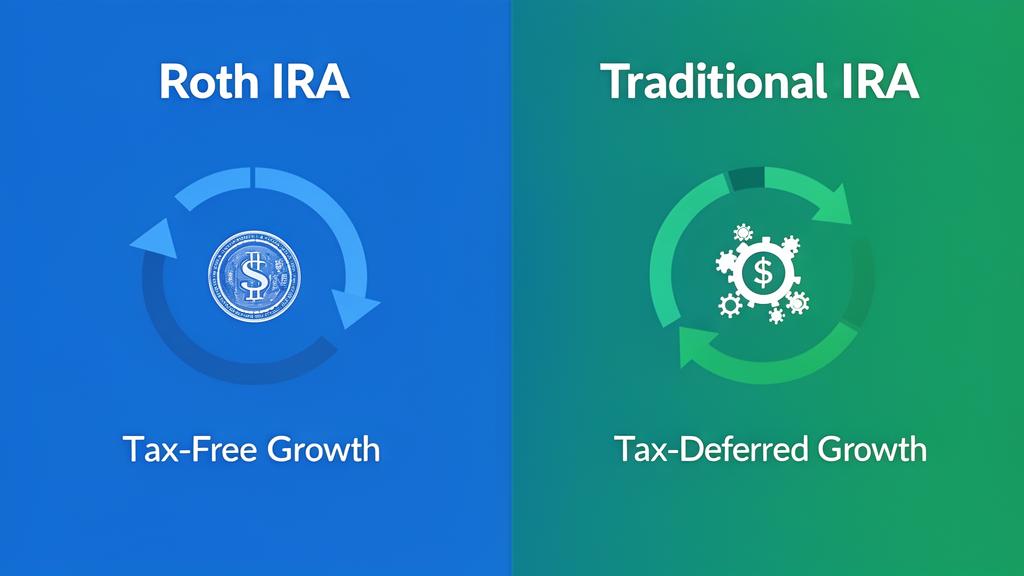
The Roth vs Traditional IRA decision ultimately comes down to a tax timing question: do you want to pay taxes now or later? With a Traditional IRA, contributions may be tax-deductible in the year you make them, reducing your current taxable income. Your money grows tax-deferred, meaning you pay no taxes on gains, dividends, or interest while the money remains in the account. However, every dollar you withdraw in retirement is taxed as ordinary income at your then-current tax rate. A Roth IRA flips this arrangement. Contributions are made with after-tax dollars - no tax deduction today. But your money grows completely tax-free, and qualified withdrawals in retirement are entirely tax-free, including all the investment gains accumulated over decades. If you contribute $6,500 per year for 30 years and your investments grow to $600,000, the Traditional IRA taxes you on every dollar withdrawn while the Roth IRA lets you keep all $600,000 without paying another cent in taxes. This difference can amount to hundreds of thousands of dollars over a multi-decade retirement.
Roth IRA vs Traditional IRA: Which Is Better for You?
Compare Roth and Traditional IRAs - tax treatment, contribution limits, withdrawal rules, and which account type fits your financial situation.
Published: March 8, 2026
What Is the Key Difference Between Roth and Traditional IRAs?
The fundamental difference is when you pay taxes. Traditional IRAs give you a tax deduction now but tax withdrawals in retirement. Roth IRAs are funded with after-tax money but provide completely tax-free withdrawals in retirement.
What Are the Contribution Limits and Income Restrictions?
For 2026, the IRA contribution limit is $7,000 ($8,000 if age 50+). Both Roth and Traditional IRAs share this limit. Roth IRAs have income limits - eligibility phases out for single filers above $150,000 and married filers above $236,000.
IRA contribution limits apply across all your IRA accounts combined - you cannot contribute $7,000 to a Traditional IRA and another $7,000 to a Roth IRA in the same year. The total across all IRAs is $7,000 for those under 50 and $8,000 for those 50 and older (the extra $1,000 is a "catch-up" contribution). Roth IRA contributions are restricted by income. For 2026, single filers with modified adjusted gross income (MAGI) above $150,000 see reduced contribution limits, and those above $165,000 cannot contribute directly to a Roth IRA at all. For married couples filing jointly, the phase-out range is $236,000-$246,000. Traditional IRA contributions have no income limits - anyone with earned income can contribute. However, the tax deductibility of Traditional IRA contributions depends on whether you or your spouse have access to an employer retirement plan. If you are covered by a workplace plan, the deduction phases out at higher incomes. High earners who exceed Roth IRA income limits can still access Roth benefits through the "backdoor Roth" strategy - contributing to a non-deductible Traditional IRA and then converting it to a Roth IRA.
When Is a Traditional IRA the Better Choice?
A Traditional IRA is better when you are in a high tax bracket now and expect to be in a lower bracket in retirement, when you need the immediate tax deduction, or when you want to reduce your current adjusted gross income.
The Traditional IRA provides the most value when your current marginal tax rate is higher than your expected retirement tax rate. If you earn $150,000 now and pay 24% federal tax on your last dollars of income, but expect retirement income of $60,000 taxed at an effective rate of 12-15%, the Traditional IRA lets you deduct contributions at 24% and pay taxes on withdrawals at a lower rate - a clear win. High earners who cannot contribute directly to a Roth IRA may find the Traditional IRA deduction particularly valuable, especially if they are not covered by an employer retirement plan (which makes the deduction available regardless of income). The Traditional IRA also makes sense when you face unusually high income in a specific year - a large bonus, stock option exercise, or business windfall - and want to reduce your tax bill. Additionally, if you expect to move from a high-tax state to a no-income-tax state in retirement (e.g., California to Florida), Traditional IRA contributions effectively convert state-taxed income into state-tax-free retirement income. Consider your complete tax picture, including state taxes, when making this decision.
When Is a Roth IRA the Better Choice?
A Roth IRA is better when you are in a low tax bracket now and expect higher taxes later, when you want tax-free income flexibility in retirement, or when you value the absence of required minimum distributions.
The Roth IRA shines brightest for younger investors in lower tax brackets who expect their income - and therefore their tax rate - to rise significantly over their careers. A 25-year-old earning $50,000 in the 12% tax bracket who contributes to a Roth IRA pays taxes on contributions at 12% but avoids paying 22-24% or more on decades of accumulated growth in retirement. Beyond the tax rate comparison, Roth IRAs offer several unique advantages. There are no required minimum distributions (RMDs) during the original owner's lifetime, allowing the account to continue growing tax-free for as long as you want. This makes Roth IRAs excellent estate planning vehicles - your heirs inherit the account and can take tax-free distributions. Roth IRA contributions (not earnings) can be withdrawn at any time without taxes or penalties, providing emergency fund flexibility that Traditional IRAs cannot match. In retirement, Roth withdrawals do not count as taxable income, which means they do not increase your Social Security taxation, Medicare premium surcharges, or ACA healthcare premium calculations. This "tax invisibility" of Roth income provides exceptional flexibility for managing your overall tax situation in retirement.
What About Roth Conversions?
Roth conversions allow you to move Traditional IRA money into a Roth IRA, paying taxes on the converted amount now in exchange for tax-free growth and withdrawals in the future.
Roth conversions are a powerful tax planning strategy that is independent of annual contribution limits - you can convert any amount from a Traditional IRA to a Roth IRA in any given year. The converted amount is added to your taxable income for the year, so strategic timing is essential. The ideal time for Roth conversions is during low-income years: early retirement before Social Security begins, a sabbatical, a career transition, or any year where your income is unusually low. By converting enough to "fill up" lower tax brackets, you effectively prepay taxes at low rates to avoid higher rates later. For example, if you retire at 55 and have $50,000 in annual expenses covered by taxable account withdrawals, you might convert $40,000-50,000 from your Traditional IRA to a Roth, paying taxes at the 12-22% bracket instead of the 24%+ bracket you might face when RMDs begin at age 73. Over 10-15 years of strategic conversions, you can shift hundreds of thousands of dollars from tax-deferred to tax-free status. Be cautious about converting too much in any single year, as a large conversion can push you into higher tax brackets and trigger Medicare premium surcharges.
Can You Have Both a Roth and Traditional IRA?
Yes, you can have both types of IRAs simultaneously. The combined annual contribution limit across all your IRAs is $7,000 ($8,000 if 50+). Many financial planners recommend contributing to both for tax diversification.
Maintaining both Roth and Traditional IRA accounts - a strategy called tax diversification - provides maximum flexibility in retirement. When you need to report higher income (for mortgage qualification or Social Security benefit calculation), draw from the Traditional IRA. When you want to minimize taxable income (for ACA subsidies or to stay in a lower bracket), draw from the Roth. This combination allows you to fine-tune your tax situation year by year based on changing circumstances. Many investors split their annual contributions between both account types, though the optimal split depends on your current and expected future tax rates. A common approach is contributing to a Roth IRA while simultaneously maxing out a Traditional 401(k) at work, achieving both current tax deductions through the 401(k) and future tax-free income through the Roth IRA. If your employer offers a Roth 401(k) option, you have even more flexibility to distribute contributions between tax-deferred and tax-free accounts. The important principle is avoiding having all your retirement savings in a single tax treatment - tax laws change over time, and diversification protects against unfavorable future changes.
What Are the Withdrawal Rules for Each IRA Type?
Traditional IRA withdrawals before 59½ incur a 10% penalty plus income taxes. Roth IRA contributions can be withdrawn anytime penalty-free, but earnings withdrawals before 59½ and before the account is 5 years old trigger taxes and penalties.
Understanding withdrawal rules is critical for both account types. Traditional IRA rules are straightforward: all withdrawals before age 59½ are subject to income tax plus a 10% early withdrawal penalty (with exceptions for first-time home purchases up to $10,000, qualified education expenses, and certain medical costs). After 59½, withdrawals are taxed as ordinary income but penalty-free. Starting at age 73, you must take Required Minimum Distributions (RMDs) based on your age and account balance - failure to take RMDs results in a 25% penalty on the amount not withdrawn. Roth IRA withdrawal rules follow an ordering system. Contributions come out first - always tax and penalty-free regardless of age. Converted amounts come out next - tax-free but subject to a 5-year waiting period per conversion to avoid the 10% penalty if you are under 59½. Earnings come out last and require both age 59½ and a 5-year account seasoning period for completely tax and penalty-free treatment. Roth IRAs have no RMDs during the owner's lifetime, allowing unlimited tax-free growth. These flexible withdrawal rules make Roth IRAs the most versatile retirement account available.

Frequently Asked Questions
Roth IRAs are generally better for young investors who are in lower tax brackets. Paying taxes at a 12% rate now to avoid paying 22-24% or more on decades of growth is a significant advantage. Young investors also have the longest time horizon for tax-free compound growth inside the Roth.
A backdoor Roth IRA is a strategy for high earners who exceed Roth IRA income limits. You contribute to a non-deductible Traditional IRA (no income limits) and then convert it to a Roth IRA. The conversion is nearly tax-free if you have no other Traditional IRA balances. This strategy is legal and widely used.
Yes, there are no limits on Roth conversion amounts. However, the entire converted amount is added to your taxable income for the year, potentially pushing you into a much higher tax bracket. Most advisors recommend spreading large conversions over several years to minimize the tax impact.
No. Roth IRA withdrawals are not counted as provisional income for Social Security taxation purposes. This means Roth income does not trigger taxation of your Social Security benefits, unlike Traditional IRA withdrawals. This is a significant advantage of Roth accounts in retirement.